



One Cable, Continuous Protection: PoE PD in AI-Powered Monitoring Applications
One Cable, Continuous Protection: PoE PD in AI-Powered Monitoring Applications
How AOK's PoE PD Solution Simplifies Deployment for Safety-Critical AIoT Systems
The Challenge: Connectivity That Has to Work in the Field
AI-powered monitoring systems — from safety surveillance to industrial inspection — are built around a simple promise: detect an event and respond within seconds. That promise depends entirely on two things being true at once: the AI device must be online, and it must be powered.
In the lab, meeting both conditions is straightforward. In a real installation — an outdoor pool facility, a factory floor, a public space — the picture is different. Cable runs are longer. Devices come from multiple manufacturers. Network infrastructure is shared. Power conditions vary. Products that passed every bench test may behave differently once installed.
The standard answer — a separate network cable and a separate power adapter for each device — adds connection points, complicates installation, and creates more places for the system to fail. In applications where a missed alert is not a minor inconvenience but a safety gap, that complexity has real consequences.
The Application: AI Safety Monitoring in Aquatic Environments
One deployment scenario that illustrates this challenge clearly is AI-powered drowning detection. These systems run cameras and mobile AI servers continuously, analyzing a live video feed in real time to detect and classify human movement in a pool or body of water.
If a swimmer appears to be in distress, the system must respond within seconds: triggering alarms, sending live-stream alerts to registered users, and initiating emergency notification. For this to work, the AI server must be online and powered without interruption — 24 hours a day, every day the facility is in use.
In an application where an alert may require a response within seconds, connectivity cannot simply be "good enough" in the lab. It has to work in the actual environment, with the actual devices, cables and power conditions.
The Solution: One Ethernet Cable. Data and Power.
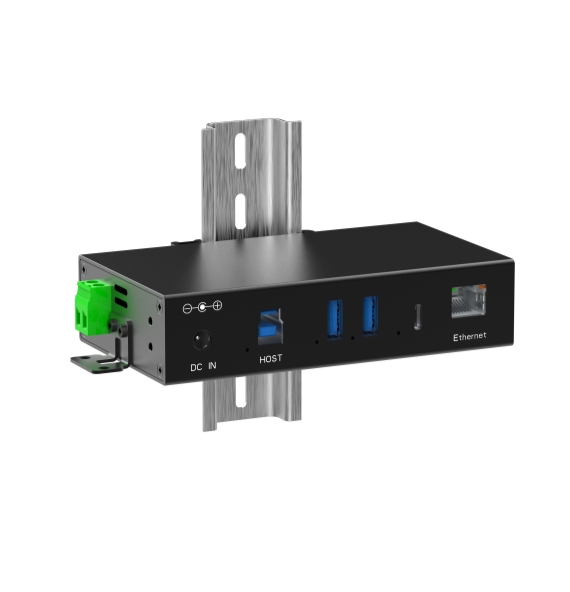
AOK's PoE PD (Power over Ethernet — Powered Device) solution addresses both requirements through a single Ethernet cable. The USB-C host device — a phone, tablet, mobile AI server, or similar — receives network connectivity and DC power from the same cable run. No separate power adapter. No additional wiring at the device end.
This simplification has direct reliability benefits. Fewer physical connections mean fewer potential failure points. A single cable run is easier to route, secure, and inspect. Power delivered from a managed PoE switch or injector can be monitored and controlled centrally — a more stable and auditable arrangement than a local power adapter plugged into a wall socket.
Core Capabilities
Single-Cable Simplicity
One standard Ethernet cable carries both data and power to the USB-C host device — reducing cable clutter and simplifying every stage of installation and maintenance.
IEEE 802.3af/at Compliant
Supports IEEE 802.3af (15.4W), 802.3at (30W) and 802.3bt (up to 90W). Compatible with managed PoE switches and injectors across all three generations of PoE infrastructure.
USB-C Host Compatible
Delivers network connectivity and charging power to USB-C devices — including phones, tablets, edge AI modules and mobile servers — without requiring a dedicated power outlet at the installation point.
Field-Validated Reliability
Tested and commissioned in real deployments, not just in a lab. AOK's engineering team verifies compatibility and power delivery under actual installation conditions before sign-off.
Application Scenarios
Aquatic Safety & Drowning Detection
AI cameras and mobile AI servers mounted at pool facilities require continuous power and network access. PoE PD eliminates the need for a local power outlet at each camera or server location, simplifying installation in environments where electrical infrastructure is limited or inconvenient to access.
Outdoor & Remote AI Surveillance
Perimeter monitoring, construction site safety, and infrastructure inspection systems that deploy AI edge devices in locations without convenient power access. A single PoE-capable cable run from the nearest network cabinet is all that is needed at each node.
Industrial AIoT Monitoring
Factory floor monitoring systems where AI cameras or sensors are mounted on equipment or in constrained spaces. PoE PD reduces the installation complexity and cable management burden at each monitoring point.
Retail & Public Space AI Analytics
People-counting, queue management, and behavior analytics systems deployed in retail, transport, or hospitality environments. PoE PD allows devices to be positioned where they provide the best coverage, not where the nearest power outlet happens to be.
What Field Support Actually Looks Like
A specification sheet describes what a product is designed to do. It does not confirm that the product will perform correctly with a specific USB-C host device, on a specific length of cable, supplied by a specific PoE switch, in a specific installation environment. Field validation closes that gap.
AOK's engineering team supports customers through the complete deployment cycle. For projects where the application is safety-critical or the installation environment is complex, that support extends to on-site commissioning. In a recent AI monitoring deployment, our team worked on-site to verify:
Network connection integrity across the full cable run
PoE power delivery under actual operating load conditions
USB-C host compatibility with the specific devices in the system
Every cable route and physical connection point in the installation
End-to-end device communication and system operation as expected
Support does not stop when the product leaves the factory. From product selection and sample testing through to on-site integration and troubleshooting, AOK's team stays involved until the system is stable in the field.
Technical Specifications
| PoE Standard | IEEE 802.3af (15.4W) / IEEE 802.3at (30W) / IEEE 802.3bt (60W / 90W) |
| Interface | RJ-45 Ethernet input; USB-C output to host device |
| Host Compatibility | USB-C devices: phones, tablets, mobile AI servers, edge modules |
| Data + Power | Both delivered over a single standard Ethernet cable |
| Cable Type | Standard Cat5e / Cat6 Ethernet |
| Certifications | CE, FCC, RoHS |
| Customization | OEM/ODM available; housing, branding and configuration options |
Specifications current as of publication. Contact our sales team to verify the latest revision before finalizing a system design.
Why AOK
AOK Electronics has developed industrial USB and network connectivity hardware since 2008. Our PoE PD solutions are designed for applications where reliable connectivity is not optional — where the system has to work in the actual environment, not just in controlled conditions.
As an OEM/ODM manufacturer with an in-house engineering team, AOK can adapt product configurations for specific application requirements and support deployment from initial product selection through to on-site commissioning. For integrators building safety-critical AIoT systems, that combination — hardware designed for the application and engineering support in the field — is what separates a product that ships from a system that works.
Deploying a PoE-powered AI monitoring system?
Contact our engineering team to discuss your application, request product samples, or arrange on-site integration support. OEM/ODM customization available.
Contact Us →


AOK Electronics Co., Ltd.
- Factory Add.:Bldg A, No.9 Changyi Rd, Wuguishan Town, Zhongshan, GuangDong, China 528400
- Tel:+86 760 8993 5569
- E-mail:info@aok-top.com

